The Show Must Go On in San Pancho
(by Dan Harvey Pedrick)

A version of this famous quote from the Roman Emperor Claudius more appropriate to the happy polo players of San Pancho might be, "We who are about to have a heckuva lot of fun salute you!" But where the heck is San Pancho, anyway? You won't find it on many maps unless you search for it by its full and proper name: San Francisco, Nayarit, Mexico. It is located some twenty-five miles north of Puerto Vallarta, just one spot in a wider region known as the Mexican Riviera. But the similarity between the unlucky gladiators of the ancient past and the present day poloists of San Pancho lies in the fact that what they do is regularly presented as spectacular entertainment for an eager audience, performing alongside musicians, dancers, magicians, circus riders, and more.
San Pancho has avoided the crowds and condos that clutter Puerto Vallarta and remains a rural Mexican fishing and farming village at heart. Its shady main street is paved with cobblestones and lined with small restaurants, surf shacks, and small B&Bs. There are no traffic lights. Dogs doze lazily on the sidewalks while hucksters hawk their wares from trucks. Although it has acquired a significant and growing population of villa-dwelling ex-pats from the U.S., Canada, South America, and Europe, the resulting demographic seems to be a happy one, marked by mutual respect, unabashed affection for the town's rustic charm, and optimism for the future.
Falling in love with San Pancho is easy, but nothing new. Luis Echeverría, Mexico's President from 1970 until 1976, did so and is recognized as the founding father and architect of San Pancho. During his presidency, he landed his presidential helicopter on the beach at least once a week to spend time visiting with the few fishermen, farmers, and their families who lived there. Claiming the entire area as his own, Echeverría set out to shape San Pancho into a model of self-sufficiency that third-world countries everywhere could emulate, and hoped his efforts would earn him a prestigious reputation as a progressive twentieth-century political leader. Instead he ended up fleeing the country amid allegations of looting the national treasury and acts of genocide against the Mexican people. But San Pancho has remained a dream magnet for many others.
"Despite its almost Lilliputian size," stated a Wall Street Journal reporter after a recent visit, "San Pancho offers plenty to do-surfing, jungle hikes, multiple yoga studios. And of course, the polo."
I wanted to plagiarize that but I didn't have the nerve.
Anyway, the polo field at San Pancho is also small by any standard. A bit wider but hardly longer than a full-sized arena, it's a blotchy mix of sand and Bermuda grass that resembles a case of male pattern baldness. But that hardly means life is not worth living or, much less, enjoying (as I should know!), because playing three-a-side chukkas on this little piece of tropical Mexican paradise is a total gas. Meanwhile, fans of big field polo take heart, because Iván Echeverría and Gabrielle Weber have a plan...
Iván Echeverría (no relation to the hapless ex-president) was born in Mexico City in 1962. He vacationed in San Pancho with his family from the age of twelve. An avid rider as a youth, Iván studied cinematography in university and later formed his own film production company. He met his future wife, Gabrielle Weber, in Mexico City where she was working as a free-lance photographer, and invited her to San Pancho.
Gabrielle Weber was born in Zurich, raised in Switzerland and Greece, and spent much of her youth sailing around the world aboard her father's fifty-four foot sailing yacht. She acquired her passion for horses as a very young child upon seeing the draught teams owned by her father's brewery. Later she studied art and education before coming to Mexico, attracted in no small way by its iconic affection for the horse, and intent on composing cultural photographic essays of the country in black-and-white images. There she met Iván and, after a year of dodging Cupid's arrows, finally surrendered to her destiny-which included full Mexican citizenship.
At first the newlyweds followed their shared passions for jumping horses-at least until the fateful day mutual friend Enrique Tron introduced them to polo at Costa Careyes. Professional polo mentor Major Hugh Dawnay took them under his wing and soon the couple were polo habitués with no hope of recovery.
Gabrielle and Iván began to visualize playing polo on a mango orchard they owned in San Pancho. The mango trees soon gave way to a stick-and-ball field but the ideas kept coming like a Jean Michel Jarre lightshow. Before long the last of the mango trees were removed from the "downtown" San Pancho location and "La Patrona Polo Club" made the transition from dream to reality. Iván and Gabrielle were already pregnant with the idea of a new polo club-cum-community in the region when Hugh Dawnay made his suggestion for the unique name that aptly characterizes and honors the serene, maternal gaze Gabrielle Weber keeps focused on the couple's creation. The Major can therefore lay claim to being the godfather of the new club.
In addition to a baby polo club the couple has two charming human teenage offspring: Alex and Tamara
Today La Patrona Polo Club functions as a restaurant, a local entertainment venue, and a small convention center as well as a player's club. Professional groups of over one hundred souls can book the facilities for retreats and seminars. As the sun drops into the western horizon-more often than not resulting in one of the spectacular sunsets the place is known for-the Power Point screens are put away and the magic begins with an exhibition polo match.
Teams are recruited from club members, visiting players, and staff. One team is usually designated to represent the visiting client group (e.g., Banamex, Aerotron Airlines, etc.) while another wears the colors of La Patrona. The teams obey the call from the announcer to line up-and this is where it starts to get dicey. This field is small, as I mentioned, and three-a-side is all it can accommodate. Umpires? Forget it. "Play clean, make it look good, and avoid knocking the ball into somebody's soup du jour," players are warned before riding onto the field.
This is show business, after all, not the Hurlingham Open.
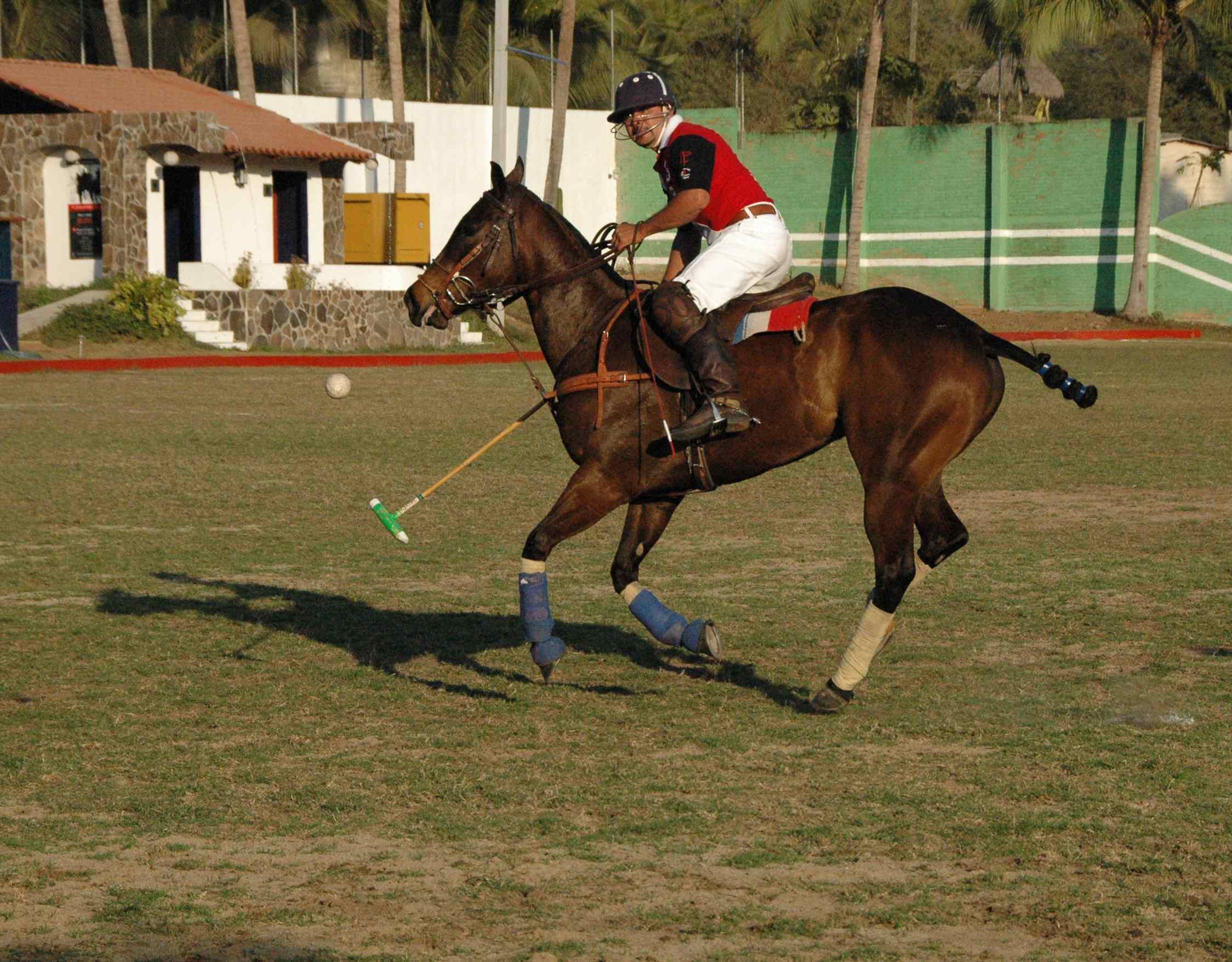
As one of the bodies press-ganged into a hastily organized troop of irregular cavalry for such an occasion, I found playing under these rather unusual circumstances easier than it looked and more fun than I could have imagined. My teammates were two young grooms, Juan Carlos and Eduardo, who prepared for the match with long draughts of "mates," an interesting example of the pervasive Argentine influence on polo clearly evident in Mexico as in so many other places. I think we were probably not favored to win our game, pitted as we were against some tough looking hombres, but we did-Ha!
"Well played, muchachos!" said Raúl Ramírez, at four goals La Patrona's resident Big Stick. It felt great to be called a muchacho again (even if it was a lie!), especially by Raúl who was one himself when I first met him more than twenty years ago while he was grooming at Costa Careyes. His raw talent was recognized by the late Major Dawnay who took him to his Whitfield Court estate in Ireland where Ramírez found the opportunity to polish his skill under the watchful eye of the well-known polo mentor and theorist.
Anyone could be a long ball hitter on this field but it's mainly a dribbling and short passing game. A regular hard polo ball is used rather than an inflated arena ball. Runoff space at the goal line is in short supply. La Patrona's horses seem to know this and the visiting players learn it fast. As the night wears on daylight fades into artificial lighting which illuminates the field. The fieldside spectators, fueled by the excellent offerings of the restaurant and bar, cheer and applaud enthusiastically. The games conclude with the familiar Ritual of the Cups, a Best Playing Pony is paraded by, and the gladiators retire from the field to thumbs up, not from an emperor but from an appreciative crowd.
"Really a lot of fun!", said Miguel Chávez, a visitor from Guadalajara who has just returned from three months playing in Florida. But the fun is just beginning. A jazz band starts to play and the jovial mood only increases.
The band takes a break and in a few moments a plaintive trumpet calls out from somewhere on the now darkened polo field. Another responds from some distance away. It is the classic Mexican composition "El Niño Perdido" performed by stealth mariachis who have taken up positions on the field unseen. Suddenly a spotlight beam cuts through the darkness to reveal a ghostly white Spanish horse with a beautiful charra astride it. It is Gabrielle (La Patrona herself!) on her magnificent "Bella." Alongside them, on foot, is one half of a Ukranian ballroom dancing champion pair, Alyona Krynina, and they are dancing an elegant choreography to the slowly cadenced arrangement. It is a literally breathtaking sight and they do not miss a step. At the end of the routine the dancers finish with a deep bow that further astounds the now spellbound audience.
The jazz band starts up again with Dave Brubeck's "Take Five," the mysterious mariachis melt away into the night, and the waiters get busier. One of the latter is young Elliot King whose family moved to San Pancho a few years ago after losing their Lake Arrowhead home in one of California's many wildfires. Elliot secured employment waiting tables at La Patrona and was soon seconded to the polo squad. Although he claims he never mounted a horse before, he is now a rapidly rising poloist whose skills include a quick change of costume after the game in order to continue performing his duties at the bar.
The floor show moves from the field onto the actual floor with Alyona and partner Aleksandr Gotochkin performing sensuous Tango routines while dancing patrons pause to catch their breath. Roberto Zenteno Solís, Mexico's greatest magician known as "Mago Spider," works the crowd with his endless and baffling sleights-of hand. Chef de cuisine Eduardo Martínez periodically emerges from his stainless steel kitchen to survey the scene.
The point is, La Patrona Polo Club and all it entails is a going concern. But Iván and Gabrielle have no intention to stop there. Just over the hill a new residential development that includes two regulation-size fields is well underway on an aggregation of contiguous properties that totals well over 300 hectares. They are determined that this new stage will build on the success they have enjoyed so far and in no way be detrimental to San Pancho or the delicate natural environment that surrounds it.
In fact the new development will exist within a special environmental zone dedicated to the protection of native animal and plant species designated and monitored by the Mexican Secretariat of Environment and Natural Resources. Orchards and croplands will be preserved wherever possible. The visibility of villas and houses will be limited by restrictions on landscaping and tree clearing. Off-grid power installations will minimize the need for power lines. A flood control project, long needed to reduce the vulnerability of the town to the vagaries of seasonal inundations from the Sierra Madre Occidental range, includes a massive reconstruction of the river channel through the valley bottom with a commitment to make the finished job look as natural as possible. Large grazing paddocks will accommodate playing ponies, the growing population of La Patrona's own breeding stock, and the personal mounts of staffers such as club veterinarian Dr. Juan Jaime Velasquez's splendid sorrel mule.
La Patrona Polo Club will be the first polo club on the planet to be created inside such a government regulated ecological zone.
La Patrona Polo Club has launched an ambitious breeding program with the goal of developing a type of cross-bred particularly suited to playing polo in the tropics. Their foundation stallion, "Opsidian," is a purebred Arabian with multiple champion racing blood lines and exceptionally friendly temperament. The broodmare herd consists of forty mares, twenty of which are purebred Arabian and half Arabian mares and the remainder Quarterhorse and Appendix mares. All have strong pedigrees and were carefully selected for best polo conformation and temperament. It is hoped to have twelve mares foal by the end of the 2011 breeding season.
Iván and Gabrielle believe the first throw-in on the new fields is no more than two years away but they plan to keep the small field going after the big ones come on line. The original facility, aside from being financially successful, is a great training ground for new ponies and players alike. Besides, La Patrona Polo Club's downtown location has become an integral part of the emerging unique personality of the community of San Pancho. Reaching out to the global community, La Patrona, in conjunction with the Mexican and International Red Cross, hosted a Japan disaster relief fundraiser on April 2nd, 2011.
"I have been coming to San Pancho since I was twelve years old," says Iván Echeverría in a passionate tone. "My goal is to care for this place as I care for my own home-because that's what it is."
(This article was published in Polo Players' Edition magazine in May, 2011. )
